
Short Russell 2000, Short Nasdaq, Watching The Dollar | Weekly Market Review W/C 19th October 2026
Market regime: transition.
The Big Picture
Last week broke the risk-on regime without turning risk-off. The selling was concentrated rather than general.
Equities. Nasdaq Composite −4.48% to 26,140 and the Russell 2000 into correction territory at 2,721.37, against a Dow +0.67% to 52,001.
Volatility. VIX 14.84 to 19.99, with 21.45% of that move on Friday alone.
Rate expectations. Fed at 3.75–4.00% and still in a hiking cycle. October hike odds collapsed to a 13–30% range, with CME FedWatch putting a hold at roughly 83.9%; December sits at 89–92%. Warsh gave nothing away in Bangkok on Friday.
Credit. ICE BofA US high yield OAS from 311bp to 331bp — the index, not just the CCC tail. CoreWeave CDS at distress levels, Oracle CDS at a record high.
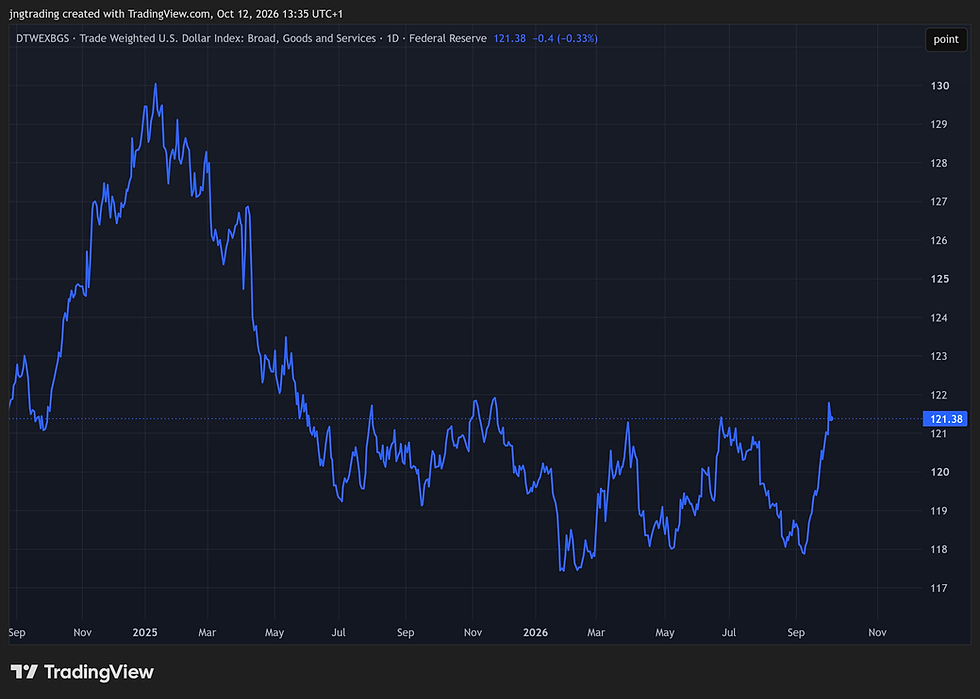
Dollar. First weekly fall in five to 101.77, with no haven bid in a week that deserved one. The Swiss franc took it instead, +0.61%.
The tell was in bonds. September CPI printed 3.7% and PPI 6.3%, the largest annual gain since 2022 — and the 10-year still fell 15bp to 5.09%, with the real yield down 17bp and breakevens up two.
1. Russell 2000 (RTY) Short — High Conviction
Small caps carry floating-rate debt, so last week's macro background transmits straight into the index: a 2-year at 4.74% and a high yield spread 20bp wider. This reprices whether or not the AI story resolves.
Second consecutive week of underperformance, this time against a widening index spread rather than a tightening one.
Weakest US index for a second week, against a Dow making record closes. That gap is the trade. Friday close 2,721.37.
Caution: +0.25% on Monday to 2,728, so this is not being sold into fresh weakness.
Invalidation: high yield OAS back below 310bp, a dovish FOMC on 28th October, or a full week of Russell outperformance versus the S&P 500.

2. Nasdaq Short — Medium/High Conviction
The macro link here is the discount rate on debt-funded AI capex, and credit is pricing it before equity. An equity question about AI monetisation has become a credit question about reaching profitability before coupons fall due.
Semiconductors fell eight consecutive sessions; the Magnificent Seven ETF lost 2% on Friday with only Apple higher.
The 10-year fell 15bp and this index still fell 4.48%. The credit repricing swamped the discount-rate relief, which tells you which force is in control.
Caution: Monday was the first counter-signal. Composite +1.11% to 26,430 and CoreWeave +6.12% on a Goldman upgrade. But credit did not follow; the spread held 331bp, and CNBC ran “Stock investors are ready to move on from the AI rout. Credit investors are not”.
Position note: large-cap technology earnings land in the final week of October, alongside the FOMC. A short held through that window is a different trade from a 2–10 day hold. Size accordingly.
Invalidation: large-cap technology Q3 earnings beating decisively, CoreWeave CDS retracing to pre-selloff levels, or a credible backstop for data-centre financing.

3. US Dollar (DXY) Short — Watching, No Position Yet
The collapse in rate expectations is the macro case, and last week's failure to catch a haven bid supports it. The entry does not.
DXY holds near 102 after gaining on Monday, with the 50-day at 102.16 and 102.50 having capped it twice this month. A short here is sold into a bounce, not a break.
No tier-one US data this week and the Fed in blackout means no catalyst before 28th October — and that catalyst is a hike risk, asymmetric against the trade.
What I need first: a decisive rejection of 102.16–102.50, or a clean break and hold below 101.60.
On expression: the euro is the awkward route, with the OAT–Bund spread at 137.4bp and Moody's reviewing France on Friday. USD/CHF is cleaner, given where the haven bid went.
Invalidation of the bias: a sustained break above 102.50, or a hawkish FOMC restoring an October-style hike premium.
What to Watch
High yield OAS, 310bp and 340bp. Below 310bp both equity shorts lose their strongest leg. Through 340bp the AI credit repricing has stopped being sector-contained, which is a regime call rather than a trade.
CoreWeave, every session. It led the move down and bounced 6.12% on Monday. The thermometer for both shorts.
DXY 102.16–102.50, and the 10-year real yield at 2.90% — a recovery through it says the growth scare is over.
Wednesday 21st October: UK CPI at a 3.4% consensus against the Bank's own 3.0% forecast. Friday 23rd: Moody's on France, global flash PMIs, Japanese CPI.
Tuesday 27th–Wednesday 28th October: FOMC, UK Budget and Bank of Canada cluster, with large-cap technology earnings in the same window. The largest risk to everything above.
Note that both equity trades are the same bet expressed twice — short the part of the market most sensitive to the cost of credit. They will not diversify each other.
The above is my own analysis at the time of writing and is not financial advice. Do your own research and manage your own risk.



Comments